Showing posts with label Korea. Show all posts

Thursday, October 27, 2011

Photo Worthy

-by Matt Leedham

For nearly three weeks in Korea, the 6 of us (my in-laws, my wife’s sister and husband, and my wife and I) took over 3,000 pictures of our experience. Even I was impressed, and I like to take pictures.

I volunteered to take on the responsibility of sorting through the pictures, organizing them, and distributing them. After hours of work, I am almost done.

There were beautiful pictures...

There were heartwarming pictures...


There were multi-generational pictures...


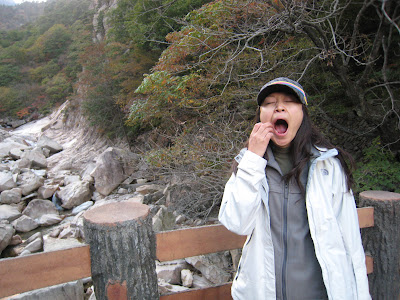
There were funny pictures...


This morning, I asked my wife why it is that we took so many pictures. She gave the obvious answer…we want to remember the good times we had. Fair enough.

But I had more questions. Why were those moments so memorable? Why take pictures of the memorable moments? If they are memorable, won’t we remember them? Is it because they were unique and we want to share them?

I began to question why we don’t take 160 pictures per day all the time. Why don’t we want to capture every moment? Why aren’t we as proud of or as interested in every moment? Do some moments carry more weight? Are they more important?

I feel blessed that I am fortunate to have a camera and a desire to write because I feel that I have documented our Korean adventure quite well and we’ll be able to enjoy both the pictures and the stories for many years. But I am left questioning the importance of recording and capturing every other moment in my life.

Some people have taken on a challenge of a picture a day for one year, like our good friend Jeff Drongowski. Others have taken on that challenge but for longer, like Dave Lesh who speaks on the topic frequently.

The idea is to take one picture per day that captures the essence of how you felt or what you experienced. It’s more challenging than you might think, but the experience, according to them, changes your perspective on life. In fact, you end up creating more memorable moments so that you can record them.

We have limited time on this earth. Are you making the most of it? Is every moment, even during your daily routine, special and memorable? Don’t you think it should be? Capture it, record it, write about it, share it with others, and appreciate every experience you have.


Tuesday, October 25, 2011

Not Better or Worse, Just Different

-by Matt Leedham

Less than 24 hours after being in Seoul, South Korea, I find myself with my wife, her sister and husband, and my in-laws walking down a narrow street near Myeong Dong. Scooters and mopeds with modified cargo bins on the back zip through the crowded alley, alight with various signs that are blinking, digitally scrolling, inflated, or moving. My Abunim (father-in-law) spots a restaurant to his liking and we scurry in, sitting 6 to a table that in America might comfortable seat 2 or 3.

The order is placed. The restaurant has maybe 15 tables and they were all packed, steam rising from the hot pots on each one that were cooking over an open flame. Empty soju bottles littered each table, and the din was more like that of a stock exchange trading floor than a restaurant.

I’m looking toward the back of the restaurant and I see waitresses using a net to dip deep into a 20+ gallon tank to scoop up 2lb-ish octopuses. This piqued my interest as to what I was about to eat. I have eaten plenty of cooked octopus and squid in Japanese, Korean, and American restaurants. But what I saw next alarmed me.

There was some commotion to my left. I turned to see a man and a woman seated a small table. He was in a suit and tie and she was dressed fashionably. They were calmly seeking the assistance of a waitress. When the waitress noticed what they needed, she bolted for the back of the restaurant and grabbed some tongs.

There was a live octopus that had successfully maneuvered out of their boiling pot of noodles, onto the table, and was clearly thinking about rappelling down the wooden leg of the table.

It was shocking for sure, but also entertaining as we all seemed to get a good chuckle.

Then our super hot serving platter of noodles arrived.

The waitress was holding a plate with a live octopus in it. She grabbed the octopus with some tongs, and shoved in the noodle dish on our table. She covered it with the contents of the dish so it was buried. I thought, “Okay, okay. This isn’t so bad…I can’t even see it.”

Then the octopus realized it was in a super hot pile of noodles and started trying to get out. Its tentacles moved all over the place, its head popped out of the top, and it was clearly straining. The struggle slowed as it cooked and eventually, it was done. The waitress used scissors to cut the octopus up into bite-size pieces and left us to enjoy our dish.

I’m a very open-minded person and love to travel, so I forced out the internal thought, “That was…um…different.” And then I ate.

This experience got me thinking. What judgments do I have around food, diet, culture, style, etc. I looked around. The restaurant is packed. People have sought out this restaurant for its fresh seafood, and are enjoying their meal. Why was my response immediately to be shocked?

For starters, it was unique to me. I’ve never eaten a dish like this, nor have I even seen something like this on TV. Second, I’ve been conditioned for 33 years to eat a certain way and have developed countless expectations about what is normal and what is not.

Sure, eating a pizza is normal for me, but there wasn’t a pizza joint for miles (and if there were it would have things like bulgogi meat and corn on it). Eating fresh seafood is absolutely normal for Koreans who live on peninsula and have depended on seafood for millennia.

What foods do we eat in America that might be considered a little weird? My family always enjoyed lobster as a treat, or when celebrating a special occasion. Occasionally, my mom would even bring home live lobster, with their claws banded, to cook at home. Is there anything strange about that?

Let’s see. First of all, lobsters are bottom-feeding, scavenging spiders of the sea. It’s actually kind of gross when you think about it. And when cooking them at home, you boil a pot of water, and drop them in head first (to limit the suffering…haha!). Then we wear silly bibs to protect our clothing, crack them open with primitive tools, eat with our hands, and create a sloppy mess within a 5-foot radius.

Still sound appealing? Try ordering a shellfish platter at the Capital Grille while hosting a group of high-ranking Muslim Turks and watch their expression (this actually happened to Jaime and I a few years ago). They’ll be repulsed and offended.

We have created layers and layers of judgments about what is normal over the years. All of our experiences have developed very significant definitions about what we “like” and “don’t like.”

But what if we release those judgments for a minute? What if we can convince ourselves that things aren’t better or worse, they’re just different. For something to be better or worse means that we have judged and labeled it as such. That kind of thinking can be very limiting.

My 3-week journey introduced me to food, places and people that were unique. With limited beliefs, my trip would have been long and exhausting. With an open mind of non-judgment, every day was a breathtaking adventure of new and wonderful experiences.

In what ways are your judgments and limited beliefs holding you back from experiencing life with wonderment and joy? Think about it.

NOTE: I could have written pages and pages about other unique experiences that challenged my thoughts around what is normal and not normal, such as sleeping on the floor, bumping into people in crowded areas, or running red lights. I also could have also used countless examples of other “weird” things we do in America, such as drink 32 ounces of soda at a time, or go “dutch” (i.e. split checks) on dates or with friends, or call our elders by their first name. These are all things that Koreans find alarming, strange, or unique in America. Keep an open mind and at least acknowledge that these judgments exist!

Thursday, October 20, 2011

Gazing Southward

-by Matt Leedham

A couple of years ago, I remember gazing southward to the horizon.  All I could see was the ocean meeting the sky, a thin line denoting the border between the two.  Ninety miles away was the island nation of Cuba.  As I stood there in Key West, I was fascinated that all that separated us was water. 

Today, I had the same fascination.  Again, I stood looking southward, barely able to tell the ocean from the sky.  This time, the next landmass emerged from the sea over 2,000 miles south in the Philippines.  I was at the southernmost point on the Southern most island in South Korea.

I treasure these moments because they center me, giving me a calibrating point from which to understand my exact position in the world.  Somehow it gives me a better sense of where I am, where I've come from, and where I'm going.  I find great peace in these places.

You may not share my excitement for such moments.  That's okay.  I've recently learned that I'm part of a unique, underground band of nerds called "mapheads." 

Before I left for this amazing journey in Korea, Jaime gave me a book written by the one and only Ken Jennings.  You may recognize his name because of his unprecedented run on the TV gameshow Jeopardy!  He holds the record for winning 74 games in a row and also holds the record for the most earnings in gameshow history.  

His new book, appropriately named, "Mapheads," reveals the closet nerdery of people like me.  I wish I could explain why I love maps so much, or why I can read and interpret them so well, but I can't.  If you're like me, you'll understand.

My interest in maps means that GPS devices also grab my attention.  The one we're using here in Korea is the best I've ever seen.  It will tell you what lane to drive in, warn you of speed bumps, and calculate distance-metered tolls.  It's really amazing.

The unfortunate result of the increased use of GPS devices is that people rely less on their own abilities to read a map and calculate their own directions.  I hope it doesn't squash any young, budding mapheads out there.

But there is a lesson to be learned from a GPS device.  It relentlessly recalculates the route any time you get off course.  Even though there is a kind, female voice coming from the box, there is no emotion behind the need to recalculate.  There is no frustration in the device when you take a wrong turn.  There is no getting upset or feeling down if an error is made.  The device simply calculates where it is currently and immediately produces a solution to get to the desired destination.

What do you do to calibrate...to get your bearing?  As our lives are filled with unending tasks and goals, do you stop and take a moment to come back to center? 

I'm guilty of it too.  In fact, before I left for Korea I had been pushing myself way too hard without finding center.  What works for me is water.  I gain great peace and clarity when near water, such as in the example above.  But rivers and lakes work too.  What's your thing?  

And once you've calibrated your position, you may need to recalculate your route.  This is a beautiful thing because it means your are moving and making progress.

I meet so many good, talented people that are afraid to pull the trigger on a project or dream or career.  They have many fears around failing, or their self image or self worth.  This is completely normal to feel this way.

The key is to move.  A GPS device won't recalculate if you are parked.  Start moving, slowly if you need to, and you will quickly learn what adjustments to make to reach your desired destination.

---

I'm signing off from Korea.  Next time you hear from me (on the 25th), I will have just gotten back to the States.  This has been an incredible adventure for which I will forever be grateful.  I hope you enjoyed reading about my experiences as much as I have enjoyed writing about them.  I'm sure there will be more to share as the weeks and months move forward and I process all that I have done and learned.

Tuesday, October 18, 2011

Driving in Korea

-by Matt Leedham

We all live by a certain set of rules.  We may not even realize what rules we've set for ourselves, but they're there.  And they can be highly limiting if we remain unaware.

Some rules have been set by our societal influences.  For example, men may feel pressure to be the bread winner in a relationship.  Similarly, women may feel pressure to be the caregiver.

Some rules have been set by our local or national governments.  Stealing, for example, is illegal in almost every society I am aware of.  Also, if there are roads and cars, stopping at red lights is usually a rule.

And some rules have been set in our minds by us, based on the experiences we have lived through.  Some people may think that they're not cut out to be successful in business because they aren't savvy or smart enough, or think that success in business and a happy family life are not compatible.  Some may think that they aren't witty enough, or funny enough, or good looking enough to be in a successful relationship.

Let me tell you something about rules that I learned in Korea.  They are at minimum negotiable, and at best breakable.

Driving in Korea is not nearly as exhilarating as driving in Turkey, India, or Costa Rica, but it is a great example of a modern nation with completely negotiable rules.  

Stopping at a red light?  Not guaranteed.

Yielding to pedestrians in a crosswalk?  Absolutely not.

The stop lights look the same (sort of).  And the crosswalks and pedestrian signs resemble that of the U.S.  So , what's the difference?

My interpretation is that societal pressures to conform in that way are not there.  And without the societal norm forcing others into submission, people started creating their own rules.

If you live in the DC area, you are familiar with the Beltway.  If you're not, the Beltway is a highway that surrounds the DC metro area in a big circle.  The speed limit is 55 miles per hour (mph).  The minimum speed limit is 35 mph.  But what happens when you are driving 48 mph?  Angry drivers are on you like white on rice, honking their horn, flashing there lights, or (if they are kind), speed up and zip around you like an Formula 1 race car driver.

Why do they do this?  It's perfectly legal to drive 48 mph on the Beltway.  What gives?

The problem is, by driving 48 mph, you are breaking an unwritten, societal norm (rule).  The herd is trying to force you back into submission by sending both aggressive and passive aggressive signals your way.

So, if Koreans can drive on the shoulder and run a red light without any problem, and if you don't like being forced into submission by societal pressures, what rules can you break?  

Don't get me wrong, and please don't break any laws.  But take a moment to examine the written and unwritten rules that govern your life.  What purpose are they serving?  Are they benefiting you and others?  What if you decided to rewrite one of those rules?  Or throw one out altogether?  

If given a chance, what new rule could you create for yourself?  Would it be one that limits you?  Or one that serves you, allows you to live by your values, and moves you toward your vision?

As always, the choice is yours.

Thursday, October 13, 2011

Intuition Without Borders

-by Matt Leedham

I've spent a lot of time this year reflecting on intuition. What exactly is it and how can I use it to help others?

I have found that when I tap into and trust my intuition, good things happen for me and others. Apparently I know things I don't know I know, and am highly perceptive and sensitive to other's feelings.

The last week I've spent in Korea has reconfirmed and reaffirmed my intuition. In the books and articles I've read on this wonderful country, they often speak of the tight bond the Korean people have with each other. My wife speaks of it too.

Having witnessed this bond myself, I feel confident that we are all connected by something much deeper than bloodlines, friendships, and proximity. There is something unexplainable that connects humans to each other. I can't describe it in detail, but I will share 3 things that happened to me yesterday that has me pondering this notion with greater intensity.

Over lunch, Halmuhni (my wife's grandmother) would tell stories about Korean culture and history. My wife would try to translate as much as possible, but I had some questions of my own. The dialog went back and forth for awhile through our translator, but I could tell that Halmuhni was energized by my inquisitive questions.

As we stood up to leave, she admitted that she was sad that she couldn't communicate with me directly, wishing that we could just sit and chat and get to know each other better.

Then she added (translated), "That's okay, we don't need words...our hearts can communicate."

That was deep.

But she's absolutely right. Without being able to say it, she knows that I care for her and love her. And I know that it brings her great joy to be a grandma to me...making sue I have enough to eat, that I sleep well, and that I am always comfortable.

Later that day we arrived in Yeosu and met up with a woman and her daughter for dinner. This was a special meal. My Abunim (father-in-law) had a childhood friend that used to live in Yeosu and this was his wife and daughter. Tragically, Abunim's best friend was killed in a car accident a couple of years ago. I was told that this may be an emotional meeting, but I didn't quite process what that meant.

When we sat down for dinner, the daughter told my wife that she wished she could speak to me and get to know me. But then added (translated), "That's okay, I know who he is by looking at his eyes. He is kind and laid back."

Again, I was impressed with how little words had to do with how we communicate.

As dinner continued, the woman told stories. Clearly she was talking about her late husband. The the rest of the room was captivated and gave her their complete, compassionate attention.

I found myself doing the same. I was completely engrossed in her story, even though I could not understand her words. I didn't need to understand the words, because I understood the emotion behind them. As she was unraveling a painful recollection, I saw the deep sadness in her eyes and could physically feel how painful it was for her to have lost her husband.

I found myself getting choked up and my eyes watered. I had no idea what she was saying but I could feel it.

This experience has really moved me. It has allowed me to see things a little differently. It's like when someone loses one of their senses, like sight or hearing, and the other senses begin to develop more strongly to compensate. My inability to understand the Korean language fully forced me to tune in at a deeper level. One that is difficult to explain but certainly exists.

How can you tap into your intuition? How can you listen more deeply, with more than just your ears, when you are with your friends, family, spouse, colleagues, etc.?

Using your intuition can help you build stronger relationships, with more understanding and appreciation. It connects us all deeply and is the foundation of our invisible human bond.

I urge you to trust your gut. If you have an intuitive hit with someone or something, do something with it. Appreciate it. You, and those around you, will gain so much from that gift.

Tuesday, October 11, 2011

Time So Fly

-by Matt Leedham

Greetings from Korea, friends!


"Time so fly."

-my Abunim

For the last 6+ years, I've listened to my father-in-law say that.

For those that don't know me well, my wife is Korean, and therefore, so are my in-laws. My father-in-law (Abunim) and my mother-in-law (Aumuhni) immigrated to the States when they were in their 20's, bringing with them my wife and her sister at the ages of 9 and 7 respectively.

Abunim's English is not that great, but that doesn't stop him from talking up a storm. He's one of the most engaging, gregarious people I know. He also has no shame, very little inhibitions, and will always say what's on his mind.

In fact, I remember one of the first times I met him. He looked at me, patted his belly, and said, "You don't exercise much, do you?"

I'll admit, I was a little taken aback with the comment. But I've come to learn that his bluntness comes from a genuine place of concern, not judgement. And now it is something that I admire and respect about him.

Anytime there is a family gathering or celebration, there is usually soju involved. Soju is an alcoholic rice wine and is Korea's equivalent to Japan's sake (but in my humble opinion is more versatile and fun to drink). When drinking soju at these gatherings, we clink glasses, say "gunbae!" (Korean for "cheers!") and put back an ounce of the good stuff.

Abunim always adds, "time so fly..."

When he first said this, I was confused. When Yu Jin (my wife) explained that he meant "time flys" I laughed out loud. Here he was reminiscing about old times and lamenting the fact that time moves so quickly, yet the words were just incorrect enough to make it funny. We now say "time so fly" anytime we celebrate, regardless of Abunim's presence.

But something happened the other night that gave me pause. I was forced to stop and think for a minute about time. I was actually completely engrossed in stories of what Korea was like 30 years ago and began to realize that time does, indeed, so fly.

Yu Jin's Halmuhni (grandmother) was telling stories of my wife's childhood before she left for America. I sat there at a restaurant overlooking the ocean on the west coast of Korea, listening to Halmuhni tell amusing tales of how she helped raise Yu Jin while her parents worked. When she was little, Yu Jin would stay outside all day playing with friends. And even when the sun went down and it got dark, she wouldn't come in. Halmuhni would have to chase after her and force her to come home.

There were times that Yu Jin, at 5 and 6 years old, would cry out for her parents when they were working. She would tell her Halmuhni that she didn't care about anything else...she just wanted her parents to be there. Like any child, the most valuable currency was her parents' time.

As Halmuhni shared her stories with much animation, Yu Jin and her sister, Yu Ra, had big smiles and some tears. It was a beautiful, emotional moment. I was honored to be there.

Nearly 30 years later, so much has changed. Everyone is older. People and places have developed. Time so fly.

I thought about my own life, just 10 years ago. My life has changed so much and so dramatically, that it's hard to comprehend. And 10 years from now, things will be much different.

But what seems to be consistent is that the speed at which time passes is relative. Time can move so slow and yet so fast. In the moment, minutes and hours can sometimes seem to drag on. Other times, they move at warp speed.

However, whenever I look back at my younger self, I always think that things have moved so quickly. Knowing this, I have a greater appreciation for the present moment.

The bottom line is, there is no practice run in life. There are no "do-overs." We've got this life to live, to appreciate, and to make the most of. Don't settle and don't wait for the right moment. Now is the right moment. Take advantage of what time you have been given and make the most of it.

Take some action on something you've been meaning to do. Have that difficult conversation you've been thinking about. Tell those around you how you feel about them.

This precious gift continues to move forward...day after day. Live it fully and live it well.
.